




Did you know that you have a better option for facial rejuvenation than costly fillers?
Microfat and Nanofat Grafting are at the forefront of modern aesthetic medicine, representing two remarkable advancements that tap into the regenerative capabilities of autologous adipose tissue.
Microfat and nanofat Grafting have emerged as cutting-edge techniques in aesthetic medicine, revolutionizing soft tissue augmentation, rejuvenation, and regenerative aesthetics.
These innovative approaches have the regenerative potential of autologous adipose tissue, offering solutions for volumetric restoration, contour refinement, and tissue regeneration. Microfat Grafting involves refining adipose tissue into larger clusters for volume augmentation or restoration and structural support, while Nanofat Grafting employs finely emulsified adipose-derived components for delicate tissue rejuvenation and skin quality enhancement.
Below are the Major differences between Microfat and Nanofat
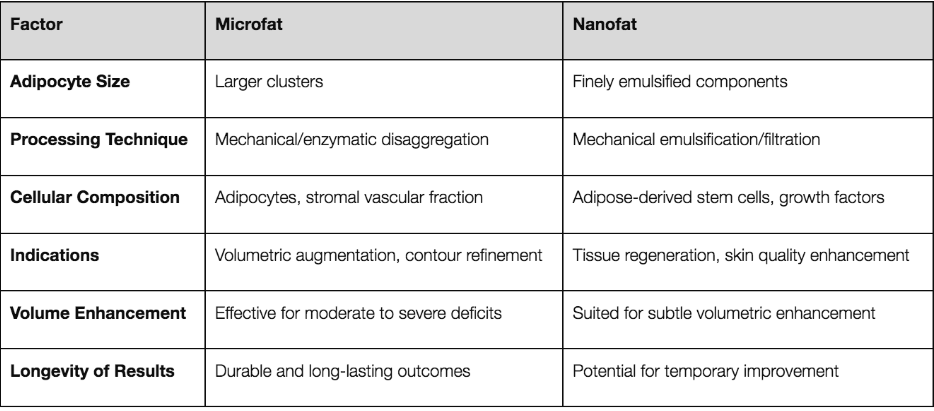

Source: Dream Plastic Surgery (2021)
In the intricate realm of aesthetic medicine, the advent of microfat Grafting represents a paradigm shift towards precision and sophistication in tissue augmentation and rejuvenation. Rooted in adipose tissue engineering and regenerative medicine principles, microfat Grafting harnesses the intrinsic regenerative potential of adipose-derived cellular components to sculpt natural contours, restore volumetric deficiencies, and rejuvenate aging tissues.
At its core, micro fat Grafting involves the meticulous processing and refinement of autologous adipose tissue to create a specialized graft enriched with adipocytes, stromal vascular fraction (SVF) components, and extracellular matrix (ECM) elements. This tailored graft composition imbues microfat with unique regenerative properties, fostering tissue integration, neovascularization, and extracellular matrix remodeling upon transplantation.
The processing of microfat begins with gently harvesting adipose tissue from donor sites using minimally invasive liposuction techniques. Subsequent mechanical and/or enzymatic processing techniques are employed to disaggregate the harvested adipose tissue into smaller clusters while preserving the integrity and viability of adipocytes and SVF components. Centrifugation or filtration may remove excess oil, blood, and debris, yielding a homogenous suspension of microfat ready for transplantation.
Clinically, microfat Grafting finds wide-ranging applications in aesthetic medicine, including facial rejuvenation, soft tissue augmentation, and scar revision. Its ability to provide durable volumetric augmentation, sculpt natural contours, and enhance tissue quality makes it an indispensable tool for clinicians seeking optimal outcomes and patient satisfaction. Moreover, the versatility of microfat Grafting allows for personalized treatment approaches tailored to individual patient needs, facial anatomy, and aesthetic goals.
Mechanism of Action
The mechanism of action for microfat Grafting involves a multifaceted interplay of cellular and molecular processes contributing to tissue regeneration, neovascularization, and extracellular matrix remodeling. This process begins from the moment of graft transplantation and continues over time as the graft integrates into the host tissue. Here’s a breakdown of the key mechanisms involved:
- Adipocyte Survival and Integration: Microfat grafts provide a scaffold of adipocytes embedded within the extracellular matrix (ECM) to the recipient tissue upon transplantation. These adipocytes and their associated ECM components facilitate the graft’s integration into the surrounding tissue. Adipocyte survival is crucial for long-term graft viability and functionality. Studies suggest that adipocytes within microfat grafts can undergo apoptosis or necrosis post-transplantation due to ischemia, inflammatory responses, and mechanical trauma during handling and injection.
- Angiogenesis and Neovascularization: Microfat grafts promote angiogenesis and the formation of new blood vessels by releasing angiogenic factors and recruiting endothelial progenitor cells (EPCs) from the stromal vascular fraction (SVF). Angiogenesis is essential for graft survival, providing oxygen and nutrients to support cellular metabolism and tissue remodeling. Growth factors such as vascular endothelial growth factor (VEGF), fibroblast growth factor (FGF), and platelet-derived growth factor (PDGF) play key roles in stimulating endothelial cell proliferation, migration, and capillary formation within the graft and surrounding tissues.
- Regenerative Cell Recruitment and Differentiation: The stromal vascular fraction (SVF) within micro fat grafts contains a heterogeneous population of regenerative cells, including adipose-derived stem cells (ASCs), endothelial progenitor cells (EPCs), and immune cells. These cells possess multipotent differentiation capabilities and secrete various trophic factors and cytokines contributing to tissue repair and regeneration. ASCs within the SVF can differentiate into multiple cell lineages, including adipocytes, endothelial cells, and pericytes, facilitating adipogenesis, vasculogenesis, and tissue remodeling within the graft and surrounding tissues.
- Extracellular Matrix (ECM) Remodeling: Microfat grafts influence the remodeling of the extracellular matrix (ECM) through the deposition, degradation, and reorganization of ECM components such as collagen, elastin, and hyaluronic acid. This remodeling process is mediated by matrix metalloproteinases (MMPs), tissue inhibitors of metalloproteinases (TIMPs), and other ECM-modifying enzymes. ECM remodeling is essential for maintaining tissue structure, elasticity, and mechanical properties and facilitating cell migration, proliferation, and differentiation within the graft microenvironment.
Advantages of Microfat
- Robust Volumetric Augmentation and Structural Integrity: Microfat grafts, characterized by larger adipocyte clusters and intact extracellular matrix (ECM) architecture, offer robust volumetric augmentation and structural support in regions requiring significant tissue replenishment, such as the midface and temples. The larger adipocyte clusters in micro fat grafts provide a stable scaffold for volumetric expansion and tissue integration, contributing to long-lasting aesthetic outcomes. The structural integrity of micro fat grafts enhances their ability to withstand dynamic facial movements and maintain long-term stability, making them ideal for addressing moderate to severe volume deficits and sculpting natural contours with precision.
- Precise Contouring and Three-Dimensional Sculpting: Microfat Grafting enables clinicians to achieve precise contouring and three-dimensional sculpting of natural contours, owing to the larger size and spatial distribution of adipocyte clusters. This allows for meticulous shaping and augmentation of anatomical regions, such as the cheeks, chin, and jawline, to harmonize with the individual’s facial anatomy and aesthetic goals. The ability of micro fat grafts to fill and shape soft tissue defects with precision minimizes the risk of overcorrection, asymmetry, and aesthetic complications, ensuring optimal outcomes and patient satisfaction.
- Durable and Long-lasting Results: Studies have demonstrated the durable and long-lasting nature of results achieved with micro fat Grafting compared to nano fat Grafting. The larger adipocyte clusters and intact ECM architecture of micro fat grafts contribute to enhanced graft survival, tissue integration, and resistance to resorption over time. Microfat grafts exhibit sustained volumetric augmentation and tissue rejuvenation effects, providing patients with enduring aesthetic improvements that withstand the test of time and aging processes.
- Versatility in Clinical Applications: Microfat Grafting offers versatility in clinical applications, spanning facial rejuvenation, soft tissue augmentation, and scar revision. Its ability to provide robust volumetric augmentation, structural support, and precise contouring makes it indispensable in addressing a wide range of aesthetic concerns and anatomical regions. From cheek augmentation and temple hollowing to lip enhancement and chin augmentation, microfat Grafting enables clinicians to tailor treatment approaches to individual patient needs, facial anatomy, and aesthetic goals, ensuring personalized and natural-looking outcomes.
Disadvantages of Microfat
- Cellular Heterogeneity and Viability Concerns: Microfat grafts exhibit cellular heterogeneity due to various cell types within the stromal vascular fraction (SVF), including adipocytes, preadipocytes, endothelial cells, and immune cells. This heterogeneity can lead to variable adipocyte viability post-transplantation, with studies reporting a significant proportion of adipocytes undergoing apoptosis or necrosis due to mechanical trauma and ischemia during processing and injection. The compromised viability of adipocytes within micro fat grafts may impair graft survival and functionality over time, limiting the long-term durability of results compared to nanofat grafts, which contain a higher concentration of viable adipose-derived stem cells (ASCs) and regenerative components.
- Inflammatory Responses and Foreign Body Reaction: Introducing micro fat grafts into host tissues can trigger inflammatory responses and foreign body reactions characterized by localized tissue inflammation, fibrosis, and potential graft resorption. The presence of non-adipocyte cellular components within microfat, such as immune cells and endothelial progenitor cells (EPCs), may exacerbate the immune response and promote chronic inflammation and fibrotic encapsulation around the graft. Chronic inflammation and fibrosis surrounding microfat grafts can compromise tissue integration, impair Vascularization, and undermine the long-term stability and survival of the graft, leading to suboptimal aesthetic outcomes and potential complications.
- Risk of Overcorrection and Aesthetic Complications: Microfat Grafting risks overcorrection, asymmetry, and aesthetic complications, particularly in dynamic facial regions with intricate anatomical structures. The inability to precisely control the volume and distribution of micro fat grafts may result in unpredictable outcomes and aesthetic irregularities, necessitating corrective interventions and compromising patient satisfaction. Clinicians must exercise caution when utilizing microfat for facial rejuvenation and contouring procedures to minimize the risk of overcorrection and asymmetry, employing meticulous injection techniques and patient-specific treatment plans to optimize aesthetic outcomes and mitigate potential complications.
Nanofat Grafting
Nanofat Grafting (NFG) refines traditional fat transfer techniques and offers a minimally invasive approach to facial rejuvenation. It goes beyond simple volume restoration, targeting skin quality improvement through a unique combination of transplanted adipose-derived stem cells (ADSCs) and regenerative growth factors.
Nanofat Grafting (NFG) stands out from traditional fat grafting techniques in two ways: it uses emulsified fat particles and focuses on cell-based rejuvenation. Traditional methods typically harvest larger fat cells, which can be challenging to inject smoothly in delicate areas like tear troughs. This can lead to a bumpy or unnatural appearance. Additionally, larger grafts struggle to establish a blood supply quickly, increasing the risk of cell death and compromising final volume correction.
NFG addresses these limitations through a more sophisticated processing technique. Centrifugation creates a suspension containing two crucial components. First, finely emulsified fat particles, ideally less than 500 microns in size, allow for smoother injection and minimize the risk of contour irregularities. These smaller particles also have a larger surface area relative to their volume, promoting better diffusion of nutrients and oxygen and ultimately improving graft survival. Centrifugation isolates the SVF, a collagen-rich fraction brimming with beneficial components. This includes adipose-derived stem cells (ADSCs) with the potential to differentiate into various cell types and contribute to long-term volume restoration and tissue regeneration. The SVF is also rich in PDGF, VEGF, and IGF-1 growth factors. These factors create a regenerative microenvironment that promotes fat graft survival and stimulates surrounding tissues. PDGF and others activate fibroblasts, the cells responsible for collagen production, leading to dermal thickening and improved skin elasticity.
In essence, NFG goes beyond simply replacing lost volume. It utilizes emulsified fat particles for smoother injection and better graft survival. More importantly, the SVF, with its stem cells and growth factors, creates a regenerative environment that improves skin quality and texture. This holistic approach leads to a more natural-looking rejuvenation with lasting effects on both volume and overall facial aesthetics.
Mechanism of Action
Nanofat Grafting (NFG) offers a paradigm shift in facial rejuvenation, surpassing traditional fat grafting by incorporating cell-based regenerative potential. This effect hinges on a complex interplay between the transplanted adipocytes and the potent cellular messengers within the Stromal Vascular Fraction (SVF). Here, we delve into the proposed mechanisms of action at a deeper level:
- Enhanced Vascularization The cornerstone of successful NFG lies in ensuring the viability of the grafted fat particles. This is where Vascular Endothelial Growth Factor (VEGF) exerts its critical influence. VEGF acts as a potent mitogen and chemoattractant for endothelial cells, the building blocks of blood vessels. Upon injection, the SVF releases a surge of VEGF, stimulating the surrounding tissues to undergo targeted vasculogenesis, the de novo formation of new blood vessels. These newly formed capillaries act as lifelines, delivering vital oxygen and nutrients to engrafted adipocytes. This meticulously orchestrated vascular network significantly improves the engraftment rate and long-term viability of the transplanted fat, ultimately leading to successful and sustained volume restoration.
- PDGF-Mediated Fibroblast Activation and Collagen Boost Beyond its volumizing effects, NFG boasts the potential to improve skin quality through a regenerative cascade mediated by growth factors within the SVF. Platelet-derived growth Factor (PDGF) plays a pivotal role in this process. PDGF acts as a key activator for fibroblasts, the resident mesenchymal cells responsible for collagen synthesis – the essential protein that provides the skin with structural integrity and youthful elasticity. By binding to specific fibroblast receptors, PDGF triggers a signaling pathway that promotes their proliferation and differentiation into mature collagen-producing fibroblasts. This results in a gradual thickening of the dermis, improving skin texture, reducing fine lines, and restoring a more youthful and supple appearance.
- The Role of ADSCs The presence of Adipose-Derived Stem Cells (ADSCs) within the SVF adds another layer of complexity and intrigue to the mechanism of action in NFG. These pluripotent mesenchymal stem cells can differentiate into various cell types, including adipocytes (fat cells) and endothelial cells (lining blood vessels). While the precise contribution of ADSCs in NFG is still under active investigation, several exciting possibilities are emerging:
- Sustained Volume Restoration: Some researchers posit that the ADSCs may differentiate into new adipocytes, potentially contributing to a more long-lasting volumizing effect compared to traditional fat grafting. This differentiation process could be further optimized through specific culture conditions or the addition of bioactive factors.
- Enhanced Neovascularization and Tissue Rejuvenation: Dining ADSCs into endothelial cells could further augment the VEGF-mediated Vascularization, ensuring a robust blood supply to the grafted fat and surrounding tissues. Additionally, these differentiated endothelial cells might contribute to overall tissue regeneration, leading to longer-lasting skin quality and texture improvements.
Advantages of Nanofat
- Minimally-Invasive Approach with Faster Recovery Unlike traditional fat grafting, which necessitates a more extensive surgical procedure with general anesthesia and extended downtime, NFG offers a significantly less invasive experience. The technique utilizes local anesthesia and a smaller cannula for fat harvesting and injection, minimizing tissue trauma and discomfort. This translates to a quicker recovery time, allowing patients to resume their daily activities sooner.
- Reduced Risk of Complications Using meticulously emulsified fat particles in NFG offers a distinct advantage over traditional methods. Larger fat grafts have a higher risk of unpredictable survival due to challenges in establishing a sufficient blood supply. The smaller size of NFG particles (less than 500 microns) promotes better diffusion of nutrients and oxygen, leading to improved graft survival rates. Additionally, the reduced size minimizes the risk of oil cyst formation, a potential complication of traditional fat Grafting.
- The Promise of Long-lasting Results through Synergistic Action While traditional fillers offer volume restoration, their effects are often temporary, necessitating re-treatment at regular intervals. NFG goes beyond simply replacing lost volume. The SVF component, rich in growth factors and stem cells, holds the potential for a more long-lasting effect. The growth factors like PDGF stimulate collagen production, leading to dermal thickening and improved skin quality. Furthermore, the possibility of ADSC differentiation into new fat cells suggests a mechanism for sustained volume correction. This synergistic action of volume restoration and cell-based rejuvenation may translate to longer-lasting aesthetic improvements than traditional fillers.
- Precise Treatment of Delicate Areas The injectable nature of NFG allows for unmatched precision in targeting delicate facial regions. Traditional fat grafting techniques can be challenging in areas like the tear troughs or around the lips due to the risk of overcorrection and visible bumps. The smaller size and smooth consistency of NFG particles enable controlled and targeted placement, minimizing the risk of irregularities and unnatural outcomes. This precision makes NFG suitable for rejuvenating these delicate areas, producing a more natural and aesthetically pleasing result.
- Potential for Combination Therapies The minimally invasive nature of NFG makes it a versatile tool that can be seamlessly integrated with other facial rejuvenation procedures. NFG can be combined with modalities like laser resurfacing or botulinum toxin injections to address various aspects of facial aging. This potential for combination therapies allows for a more comprehensive approach to facial rejuvenation, tailoring the treatment plan to each patient’s needs and concerns.
Disadvantages of Nanofat
- Cellular Dispersion and Reduced Viability: Nanofat grafts, characterized by finely emulsified adipose-derived components, may exhibit reduced cellular viability and functionality compared to larger adipocyte clusters found in micro fat grafts. The mechanical emulsification process used to create nanofat may induce cellular trauma and compromise the viability of adipose-derived stem cells (ASCs) and other regenerative components. Studies suggest that the smaller size of adipose-derived components in nanofat grafts may decrease cellular viability post-transplantation, leading to diminished therapeutic efficacy and suboptimal outcomes in tissue regeneration and skin rejuvenation.
- Limited Structural Support and Volumetric Augmentation: Nanofat grafts may lack the structural integrity and volumizing capacity required for substantial tissue augmentation and contour refinement in regions with significant volume deficits. The finely dispersed nature of adipose-derived components in nano fat may limit its ability to provide robust structural support and sculpt natural contours compared to micro fat grafts. Clinically, this limitation may manifest as inadequate volumetric enhancement, particularly in cases requiring moderate to severe volume restoration or contouring precision, such as cheek augmentation or chin augmentation.
- Variable Therapeutic Efficacy and Predictability: The therapeutic efficacy of nanofat Grafting may vary depending on factors such as donor site variability, processing techniques, and patient-specific factors. The heterogeneous nature of nanofat grafts and potential variability in cellular viability and growth factor content can lead to unpredictable treatment outcomes and variable patient response rates. Clinicians may encounter challenges in achieving consistent and reproducible results with nanofat Grafting, necessitating careful patient selection, optimization of processing protocols, and ongoing monitoring to ensure favorable therapeutic outcomes.
- Risk of Tissue Overloading and Aesthetic Complications: Nanofat grafting risks tissue overloading and aesthetic complications, particularly in delicate facial regions with limited adipose tissue availability and dynamic muscular activity. The finely dispersed nature of nano fat may result in inadvertent overcorrection, asymmetry, or irregularities, compromising aesthetic outcomes and patient satisfaction. Clinicians must exercise caution when utilizing nano fat for facial rejuvenation and soft tissue augmentation, employing meticulous injection techniques and conservative volume adjustments to minimize the risk of aesthetic complications and optimize treatment outcomes.
Microfat vs Nanofat: A Quick Overview
This table compares micro fat and nanofat grafting techniques, elucidating their differences in cellular composition, processing methodologies, and clinical applications. Understanding these distinctions is essential for clinicians seeking to optimize treatment strategies and achieve optimal outcomes in aesthetic medicine.
In the evolving landscape of aesthetic medicine, micro fat, and nanofat grafting techniques stand as transformative modalities, leveraging the regenerative potential of autologous adipose tissue to redefine facial rejuvenation and tissue augmentation. Microfat Grafting, characterized by its larger adipocyte clusters and robust structural integrity, excels in volumetric restoration and contour refinement. It offers durable and personalized solutions for addressing moderate to severe volume deficits. Conversely, nanofat Grafting, with its finely emulsified adipose components and regenerative milieu rich in adipose-derived stem cells and growth factors, presents a minimally invasive approach to tissue rejuvenation and skin quality enhancement. While micro fat provides unparalleled structural support, nanofat delicately revitalizes tissues, catering to nuanced aesthetic goals. These techniques epitomize the convergence of science and artistry in aesthetic medicine. They empower clinicians to sculpt natural, harmonious outcomes that transcend conventional augmentation, ensuring patient satisfaction and confidence in their aesthetic journey.
Microfat Grafting
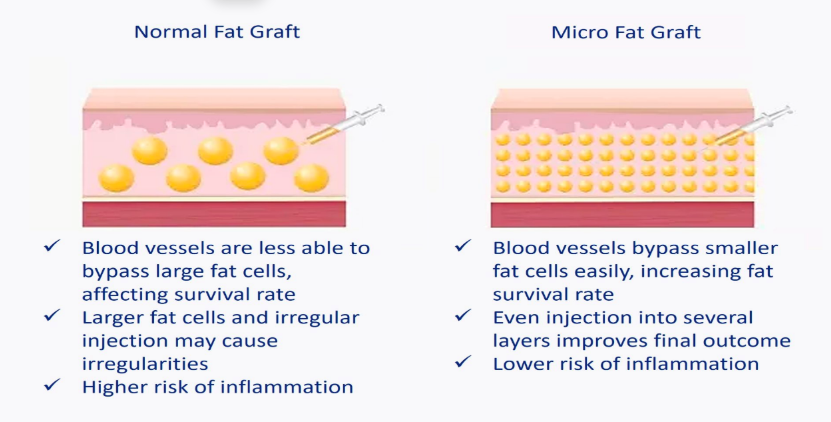
Microfat Grafting involves the meticulous processing and refinement of autologous adipose tissue to create a specialized graft enriched with adipocytes, stromal vascular fraction (SVF) components, and extracellular matrix (ECM) elements. Microfat Grafting is used for tissue augmentation and rejuvenation.
The processing of microfat Grafting begins with gently harvesting adipose tissue from donor sites using minimally invasive liposuction techniques. Subsequent mechanical and/or enzymatic processing techniques are employed to disaggregate the harvested adipose tissue into smaller clusters while preserving the integrity and viability of adipocytes and SVF components. Centrifugation or filtration may remove excess oil, blood, and debris, yielding a homogenous suspension of microfat ready for injection.
USES: microfat Grafting finds wide-ranging applications in aesthetic medicine, including facial rejuvenation, soft tissue augmentation, and scar revision. Its ability to provide durable volumetric augmentation, sculpt natural contours, and enhance tissue quality makes it an indispensable tool for clinicians seeking optimal outcomes and patient satisfaction.
Advantages of Micro Fat Grafting
- Significant Volumetric Augmentation and Structural Integrity: Microfat grafts, characterized by larger adipocyte clusters and intact extracellular matrix (ECM) architecture, offer robust volumetric augmentation and structural support in regions requiring significant tissue replenishment, such as the midface and temples. The larger adipocyte clusters in micro fat grafts provide a stable scaffold for volumetric expansion and tissue integration, contributing to long-lasting aesthetic outcomes.
- Precise Contouring and Three-Dimensional Sculpting
- Durable and Long-lasting Results: Studies have demonstrated the durable and long-lasting nature of results achieved with micro fat Grafting compared to nanofat Grafting
Nanofat Grafting
Nanofat Grafting (NFG) refines traditional fat transfer techniques and offers a minimally invasive approach to facial rejuvenation. It goes beyond simple volume restoration, targeting skin quality improvement through a unique combination of transplanted adipose-derived stem cells (ADSCs) and regenerative growth factors.
Nanofat Grafting (NFG) stands out from traditional fat grafting techniques in two ways: it uses emulsified fat particles and focuses on cell-based rejuvenation. Traditional methods typically harvest larger fat cells, which can be challenging to inject smoothly in delicate areas like tear troughs. This can lead to a bumpy or unnatural appearance. Additionally, larger grafts struggle to establish a blood supply quickly, increasing the risk of cell death and compromising final volume correction.
NFG addresses these limitations through a more sophisticated processing technique. Centrifugation creates a suspension containing two crucial components. First, finely emulsified fat particles, ideally less than 500 microns in size, allow for smoother injection and minimize the risk of contour irregularities. These smaller particles also have a larger surface area relative to their volume, promoting better diffusion of nutrients and oxygen and ultimately improving graft survival. Centrifugation isolates the SVF, a collagen-rich fraction brimming with beneficial components. This includes adipose-derived stem cells (ADSCs) with the potential to differentiate into various cell types and contribute to long-term volume restoration and tissue regeneration. The SVF is also rich in PDGF, VEGF, and IGF-1 growth factors. These factors create a regenerative microenvironment that promotes fat graft survival and stimulates surrounding tissues. PDGF and others activate fibroblasts, the cells responsible for collagen production, leading to dermal thickening and improved skin elasticity.
In summary, NFG goes beyond simply replacing lost volume. It utilizes emulsified fat particles for smoother injection and better graft survival. More importantly, the SVF, with its stem cells and growth factors, creates a regenerative environment that improves skin quality and texture. This holistic approach leads to a more natural-looking rejuvenation with lasting effects on both volume and overall facial aesthetics.
At EternaMD, we offer the latest and best technology for harvesting adipose tissue, yielding the highest-quality Micro and Nanofat to meet your cosmetic and rejuvenation needs.
The secret to a younger and more natural look lies within yourself, in the power of your fat cells.
Fat cells are extremely rich in growth factors and are an excellent source of stem cells, so from now on, don’t think of fat as the enemy, as within them lies great regenerative power.
If you are thinking about facial rejuvenation and want a more natural, autologous source, consider the alternative of having face fat transferred instead of fillers like Hyaluronic acid or calcium Hydroxyapatite.
When a fat transfer is done, knowing the difference between micro fat and nanofat is extremely important.

Dr. Carlos Mercado
Dr. Carlos Mercado, founder of Eterna MD Medical Rejuvenation Center in Orlando, FL, is a renowned cosmetic surgeon known for his innovation and patient-focused approach. Since founding Eterna MD in 2006, he has pioneered procedures like the Colombian Butt Lift, Colombian Liposculpture, and Erectus Shots, while advancing regenerative medicine in aesthetics. With decades of experience, Dr. Mercado has trained surgeons globally, authored new techniques, and earned accolades including Doctor of the Year in Florida and recognition as one of America’s Best Doctors. A member of multiple prestigious medical organizations, he continues to lead in cosmetic surgery, helping patients achieve lasting, transformative results.

 English
  Spanish